Aristophanes Contents A licence for slander | Surviving plays | Related pages | References | Other websites | Navigation menuThe Frogs at the Internet Classics archive (English version)
450s BC births385 BC deathsAncient Greek writers
GreekcomediessatiresAncient Greek theatrefestivalDionysiaDionysus
Aristophanes
Jump to navigation
Jump to search
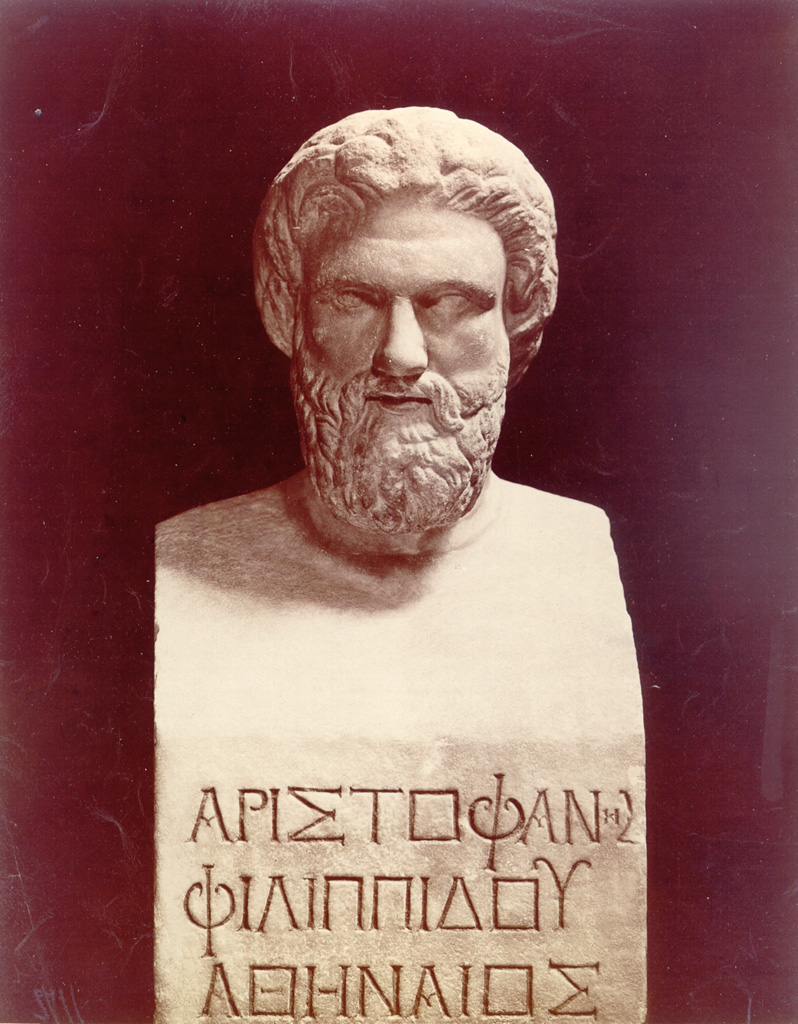
Aristophanes
Aristophanes (born around 450/445 BC – died around 385 BC) was a Greek writer who wrote 40 plays. However, only 11 of his plays survive in their entirety. He is famous for writing comedies. They were biting satires aimed at famous men of his day, and the all-too-human weaknesses of ordinary people.
His most famous play, Lysistrata, is about a group of women who protest against a war by not having sexual intercourse with their husbands until the war is ended.
Ancient Greek theatre was first presented in competitions at the festival of Dionysia, dedicated to the god Dionysus. The interesting thing is that Aristophanes did not always win first prize. The plays which won ahead of his have been lost, so we cannot make any comparisons.
Contents
1 A licence for slander
2 Surviving plays
3 Related pages
4 References
5 Other websites
A licence for slander |
George Grote said of Aristophanes:
- "Never probably will the full power of unshackled comedy be so exhibited again...the unsparing licence of attack upon the gods, the institutions, the politicians, philosophers, poets, private citizens... and even upon the women of Athens".
- "[Athenians] bore with good-humoured indulgence the full outpouring of ridicule... upon those democratic institutions to which they were sincerely attached... The democracy was strong enough to tolerate unfriendly tongues either in earnest or in jest.[1]p450/452
Surviving plays |
The Acharnians (425 BC) Aristophanes shows he will not give in to political intimidation. The play is notable for absurd humour, and an imaginative appeal for an end to the Peloponnesian War
The Knights (424 BC) The play is a satire on the social and political life of Athens and a scurrilous attack on the pro-war populist Cleon. Cleon had prosecuted Aristophanes for slandering the city in an earlier play, The Babylonians (426 BC: it has not survived). Aristophanes had promised revenge in The Acharnians, and it was in The Knights that his revenge was taken.
The Clouds (original 423 BC, uncompleted revised version from 419–416 BC survives) It pokes fun at Socrates and intellectual fashions in classical Athens. The first known "comedy of ideas".
The Wasps (422 BC) Aristophanes ridicules the law courts, which provided Cleon with his power-base:. Also has a young man vs old man theme which re-appears in several plays.
Peace (first version, 421 BC) just a few days before the end the ten year old Peloponnesian War. The play is notable for its celebration of a return to life in the countryside. But the ending is not happy for everyone. As in all Aristophanes' plays, the jokes are numerous, the action is wildly absurd and the satire is savage. Cleon, the pro-war populist leader of Athens, is once again a target, even though he had died in battle just a few months earlier.
The Birds (414 BC) A fantasy, remarkable for its mimicry of birds and for its songs.
Lysistrata (411 BC) The best-known of his plays, often produced in modern versions. The play is notable for being an early exposé of sexual relations in a male-dominated society.
Thesmophoriazusae (The Festival Women, first version, c. 410 BC) A parody of Athenian society, with a focus on the role of women in a male-dominated society, the vanity of poets such as Euripides and Agathon, and the shameless vulgarity of ordinary Athenians.
The Frogs (405 BC) A play on the theme “old ways good, new ways bad”.[2] The Frogs tells the story of the god Dionysus, who travels to Hades with his slave Xanthias, who is smarter and braver than he is, to bring the playwright Euripides back from the dead.
Ecclesiazousae (The Assemblywomen, c. 392 BC) is similar in theme to Lysistrata. Much of the comedy comes from women involving themselves in politics. The play is much more infused with gender issues than Lysistrata.
Plutus (Wealth, second version, 388 BC) The play features an elderly Athenian citizen, Chremylos, and his slave. Chremylos presents himself and his family as virtuous but poor, and has gone to seek advice from an oracle. The advice he gets is to follow the first man he meets and take him home with him. That man turns out to be the god Plutus — who is, contrary to expectations, a blind beggar. After much argument, Plutus is convinced to enter Chremylus' house, where his sight is restored. The plot can be read as: wealth will now go only to those who deserve it in some way.
Related pages |
- Theatre of Ancient Greece
References |
↑ Grote, George 1850. History of Greece, vol VIII. Murray, London.
↑ Dover, Kenneth (1997). Aristophanes' Frogs. New York: Clarendon Press. ISBN 0-19-815071-7..mw-parser-output cite.citationfont-style:inherit.mw-parser-output .citation qquotes:"""""""'""'".mw-parser-output .citation .cs1-lock-free abackground:url("//upload.wikimedia.org/wikipedia/commons/thumb/6/65/Lock-green.svg/9px-Lock-green.svg.png")no-repeat;background-position:right .1em center.mw-parser-output .citation .cs1-lock-limited a,.mw-parser-output .citation .cs1-lock-registration abackground:url("//upload.wikimedia.org/wikipedia/commons/thumb/d/d6/Lock-gray-alt-2.svg/9px-Lock-gray-alt-2.svg.png")no-repeat;background-position:right .1em center.mw-parser-output .citation .cs1-lock-subscription abackground:url("//upload.wikimedia.org/wikipedia/commons/thumb/a/aa/Lock-red-alt-2.svg/9px-Lock-red-alt-2.svg.png")no-repeat;background-position:right .1em center.mw-parser-output .cs1-subscription,.mw-parser-output .cs1-registrationcolor:#555.mw-parser-output .cs1-subscription span,.mw-parser-output .cs1-registration spanborder-bottom:1px dotted;cursor:help.mw-parser-output .cs1-ws-icon abackground:url("//upload.wikimedia.org/wikipedia/commons/thumb/4/4c/Wikisource-logo.svg/12px-Wikisource-logo.svg.png")no-repeat;background-position:right .1em center.mw-parser-output code.cs1-codecolor:inherit;background:inherit;border:inherit;padding:inherit.mw-parser-output .cs1-hidden-errordisplay:none;font-size:100%.mw-parser-output .cs1-visible-errorfont-size:100%.mw-parser-output .cs1-maintdisplay:none;color:#33aa33;margin-left:0.3em.mw-parser-output .cs1-subscription,.mw-parser-output .cs1-registration,.mw-parser-output .cs1-formatfont-size:95%.mw-parser-output .cs1-kern-left,.mw-parser-output .cs1-kern-wl-leftpadding-left:0.2em.mw-parser-output .cs1-kern-right,.mw-parser-output .cs1-kern-wl-rightpadding-right:0.2em
Other websites |
- The Frogs at the Internet Classics archive (English version)
Categories:
- 450s BC births
- 385 BC deaths
- Ancient Greek writers


(RLQ=window.RLQ||[]).push(function()mw.config.set("wgPageParseReport":"limitreport":"cputime":"0.120","walltime":"0.140","ppvisitednodes":"value":169,"limit":1000000,"ppgeneratednodes":"value":0,"limit":1500000,"postexpandincludesize":"value":1496,"limit":2097152,"templateargumentsize":"value":76,"limit":2097152,"expansiondepth":"value":7,"limit":40,"expensivefunctioncount":"value":0,"limit":500,"unstrip-depth":"value":1,"limit":20,"unstrip-size":"value":3145,"limit":5000000,"entityaccesscount":"value":0,"limit":400,"timingprofile":["100.00% 104.626 1 Template:Reflist","100.00% 104.626 1 -total"," 84.81% 88.734 1 Template:Cite_book"," 2.97% 3.108 1 Template:Main_other"],"scribunto":"limitreport-timeusage":"value":"0.051","limit":"10.000","limitreport-memusage":"value":1329943,"limit":52428800,"cachereport":"origin":"mw1334","timestamp":"20190606164037","ttl":2592000,"transientcontent":false););"@context":"https://schema.org","@type":"Article","name":"Aristophanes","url":"https://simple.wikipedia.org/wiki/Aristophanes","sameAs":"http://www.wikidata.org/entity/Q43353","mainEntity":"http://www.wikidata.org/entity/Q43353","author":"@type":"Organization","name":"Contributors to Wikimedia projects","publisher":"@type":"Organization","name":"Wikimedia Foundation, Inc.","logo":"@type":"ImageObject","url":"https://www.wikimedia.org/static/images/wmf-hor-googpub.png","datePublished":"2006-05-16T11:23:51Z","dateModified":"2018-11-27T18:36:37Z","image":"https://upload.wikimedia.org/wikipedia/commons/8/83/Aristofanes.jpg","headline":"Athenian playwright of Old Comedy"(RLQ=window.RLQ||[]).push(function()mw.config.set("wgBackendResponseTime":114,"wgHostname":"mw1247"););


